Scientists of the 1950s and 1960s were making groundbreaking discoveries, the Space Race was underway, and people were imagining a future filled with possibilities. And all that excitement made its way into American homes!
Furniture took on unusual shapes, lighting fixtures began resembling atoms and satellites, and everyday household items started looking like something out of a science fiction movie.
This retro-futuristic style is known as Atomic Age design. In this guide, we take a closer look at where it came from, what makes it special, and some of the designers and architects who are most closely linked to shaping it.
What Is Atomic Age Design?
Atomic Age design is a retro-futuristic design style that emerged in the mid-1940s and became especially popular throughout the 1950s and early 1960s. Inspired by scientific discoveries, atomic energy, and space exploration, the style is known for its geometric shapes, starburst patterns, bold colors, and futuristic furniture.
What Inspired Atomic Age Design?
The Atomic Age and Scientific Discovery
The Atomic Age began in 1945, when the first nuclear weapon was detonated during the Trinity test in New Mexico.
While nuclear technology brought plenty of fear and uncertainty, people were also fascinated by the possibilities of atomic energy and what it could mean for the future.
As scientists explored the possibilities of atomic energy, the public became increasingly familiar with images of atoms, electrons, and molecular structures. These scientific symbols soon found their way into furniture, textiles, wallpaper, lighting, and other decor.
And the influence wasn't limited to scientific imagery. The postwar interest with technology encouraged designers to experiment with new materials, manufacturing methods, and ideas about what modern living could look like.
The Space Race and Visions of the Future
The Space Race brought another wave of inspiration to Atomic Age design.
In 1957, the Soviet Union launched Sputnik 1, the world's first artificial satellite. The launch sparked worldwide interest in space exploration and helped make futuristic design even more popular.
Suddenly, satellites, rockets, planets, and spacecraft were everywhere. These shapes appeared in everything from children's toys and advertisements to furniture and home decor.
Designers started playing with forms that emphasized this excitement about the future, while architects embraced dramatic buildings that looked unlike anything built in previous decades.
Features That Are Specific to Atomic Age Design
1. Starburst and Sputnik Shapes
Starbursts are probably one of the most familiar motifs in Atomic Age design. These shapes typically feature long, thin rays extending from a central point, sometimes with circles or other geometric details at the ends.
Sputnik-inspired designs have a similar appearance, often with a central sphere with multiple arms radiating outward.
2. Atomic and Molecular Patterns
Scientific illustrations had a major influence on Atomic Age patterns, with designers incorporating circles, intersecting lines, orbit-like rings, and abstract geometric shapes into decorative patterns. Some closely resembled diagrams of atoms and molecules, while others took a more abstract approach.
3. Boomerang and Kidney Shapes
Atomic Age design took a similar approach to mid century modern design and leaned into unusual silhouettes, including boomerang shapes, kidney-shaped surfaces, and asymmetrical forms.
4. Bold and Contrasting Colors
Turquoise, coral, pink, mustard yellow, orange, and bright red were all popular choices, often paired with black, white, or metallic accents. Pastel colors were big in 1950s kitchens and bathrooms, while brighter palettes showed up throughout the home.
5. Futuristic Furniture Silhouettes
Chairs had curved shells, pedestal bases, and sculptural shapes, while tables and other furniture incorporated unusual angles and asymmetrical shapes. Some designs even resembled spacecraft or futuristic pods.
6. New Materials
Technological advancements also changed what furniture could be made from. Fiberglass, molded plywood, plastics, aluminum, and other industrial materials became a big part of furniture and product design.
These materials gave designers more freedom to experiment with funky shapes while keeping furniture lightweight and comfortable.
Iconic Atomic Age Furniture and Decor Designs
Atomic Age design gave us some of the most memorable home accessories and decorative products of the 1950s and 1960s.
While many were created by designers working within the broader mid century modern movement, certain pieces became especially linked with the Atomic Age aesthetic. Here are some of our favorites!
1. George Nelson Associates Ball Clock
Introduced in 1949 by the Howard Miller Clock Company, the Ball Clock is a perfect example of how scientific imagery found its way into everyday home decor.
The clock features a central face surrounded by thin rods with colorful wooden balls at their ends, resembling the ball-and-stick models used to illustrate atomic and molecular structures.
Although commonly associated with George Nelson, the clock was designed by Irving Harper, who worked for George Nelson Associates.
2. Sputnik Chandeliers
Sputnik chandeliers became one of the most popular lighting styles associated with the Atomic Age.
These fixtures feature a central sphere with multiple arms extending outward, usually ending in exposed light bulbs.
The design is closely associated with the era's fascination with satellites and space exploration, particularly following the launch of Sputnik 1 in 1957.
Although Sputnik chandeliers come in many variations rather than one universally recognized original design, they're still a classic example of retro-futuristic lighting.
Sculptural Furniture
One famous example is Eero Saarinen's Tulip Chair, introduced in 1956.
Instead of four traditional legs, the chair features a single pedestal base and a curved, sculptural seat. Saarinen wanted to eliminate the visual clutter created by conventional chair legs.
While the Tulip Chair is technically a mid century modern design rather than a specifically atomic-inspired piece, its futuristic appearance made it a natural fit for space-age interiors.
3. Franciscan Starburst Dinnerware
Franciscan Starburst dinnerware, introduced in 1954, featured an abstract pattern of colorful starbursts against a light background.
The pattern was designed by Mary C. L. Brown and appeared on the Eclipse dinnerware shape developed by George James.
Today, vintage Franciscan Starburst dishes are especially popular among collectors of mid century modern kitchenware.
4. Formica Boomerang Laminates
One of the most recognizable Atomic Age patterns appeared on an everyday household material: decorative laminate.
Formica's boomerang-patterned laminates became popular during the 1950s, appearing on kitchen countertops, dining tables, and other household surfaces.
The pattern featured irregular, angled shapes scattered across the surface, often in contrasting colors.
These laminates made it possible to bring Atomic Age style into an ordinary American kitchen without investing in expensive custom furniture.
5. George Nelson Associates Sunburst Clock
Another popular design associated with George Nelson Associates is the Sunburst Clock.
Introduced as part of the firm's decorative clock collection, it features pointed wooden rays extending outward from a circular clock face.
Unlike the Ball Clock's rounded details, the Sunburst Clock has a sharper, more angular appearance.
6. Atomic-Patterned Wallpaper and Textiles
Atomic Age design also introduced some unforgettable patterns for the home.
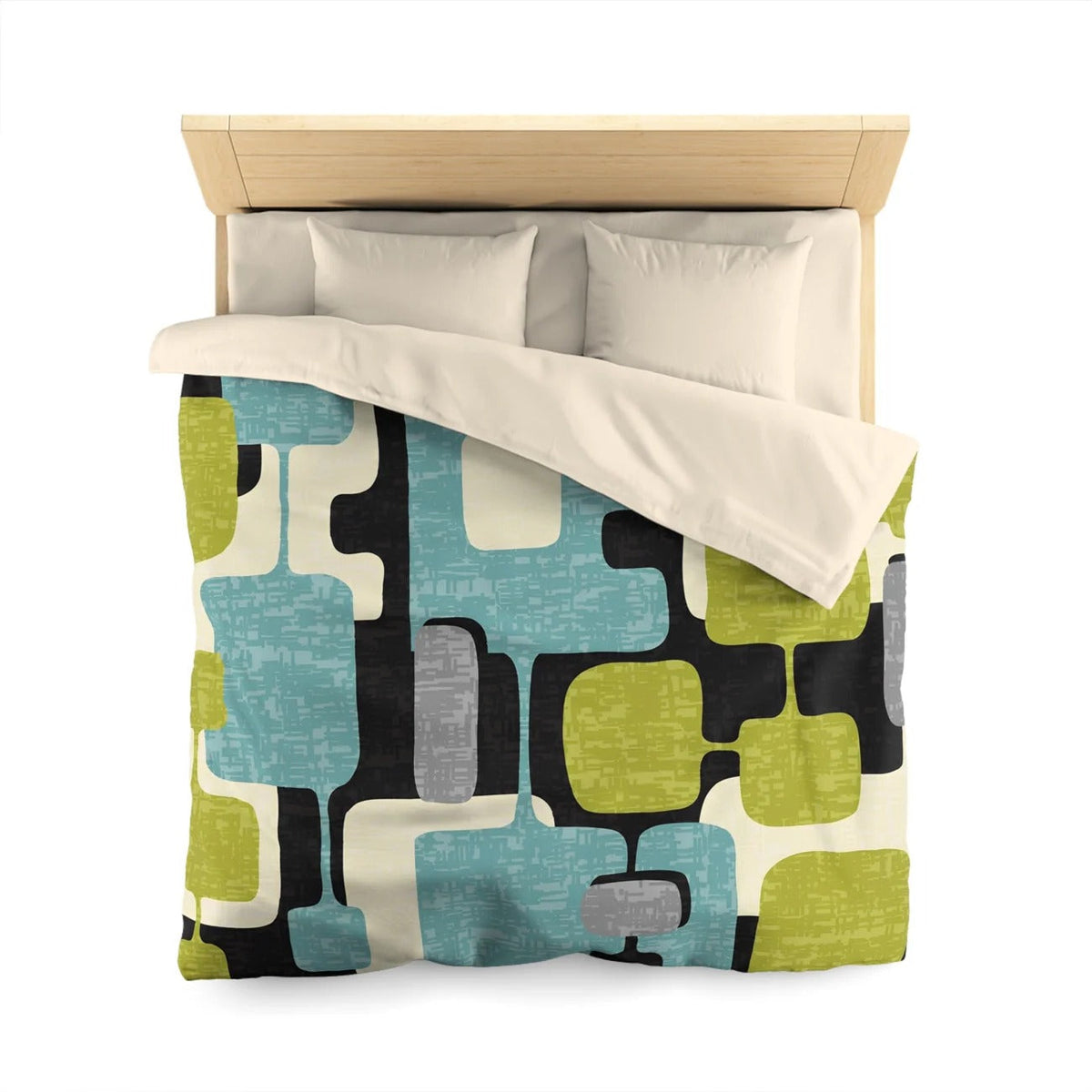
Wallpaper, curtains, upholstery, and other textiles frequently featured abstract illustrations inspired by scientific diagrams.
Designs incorporated colorful starbursts, intersecting lines, irregular shapes, and scattered geometric motifs.
Unlike the named furniture and decorative products above, these patterns were produced by numerous manufacturers and textile designers throughout the period.
They gave homeowners an affordable way to incorporate Atomic Age design into their interiors, even without purchasing new furniture.
Atomic Age Architects and Their Most Popular Builds
1. John Lautner
If you've ever seen photos of the Chemosphere House in Los Angeles, you already know just how futuristic John Lautner's designs could get.
Built in 1960, the house sits atop a single concrete column in the Hollywood Hills. Its octagonal shape and elevated structure make it look remarkably similar to a flying saucer.
But Lautner's influence on Atomic Age architecture started even earlier.
In 1949, he designed Googie’s Coffee Shop in Los Angeles, the building that eventually gave Googie architecture its name.
The coffee shop featured dramatic angles and an eye-catching roofline that stood out from traditional commercial buildings.
Notable Builds:
-
Googie’s Coffee Shop (1949)
-
Chemosphere House (1960)
-
Silvertop (1963)
2. Louis Armet and Eldon Davis
If you love the look of classic 1950s diners and coffee shops, you'll definitely want to know about Louis Armet and Eldon Davis.
Together, they founded the architectural firm Armet & Davis in 1947 and became especially well known for designing futuristic restaurants throughout Southern California.
One of their most famous projects is Pann's Coffee Shop in Los Angeles, which opened in 1958.
With its sweeping roof, expansive windows, and colorful interior, Pann's is a great example of Googie architecture.
The firm also designed several other Southern California coffee shops that became landmarks of mid-century roadside architecture.
Notable Builds:
-
Norms La Cienega (1957)
-
Pann's Coffee Shop (1958)
-
Johnie's Coffee Shop (1956)
3. Helen Liu Fong
While Louis Armet and Eldon Davis were designing futuristic coffee shops throughout Southern California, Helen Liu Fong was helping bring their interiors together.
Fong joined Armet & Davis in 1951 and became especially well known for her work designing the interiors of the firm's restaurants.
Her work on Pann's Coffee Shop is particularly memorable, with its colorful seating, decorative details, and distinctly mid-century atmosphere.
She also contributed to the interiors of other well-known Los Angeles coffee shops, helping create some of the most memorable commercial spaces of the period.
Notable Projects:
-
Pann's Coffee Shop (1958)
-
Johnie's Coffee Shop (1956)
-
Norms restaurants
4. Wayne McAllister
Wayne McAllister was another important figure in the development of Googie architecture, particularly when it came to roadside restaurants and hotels.
One of his most famous projects is the Bob's Big Boy restaurant in Burbank, California, which opened in 1949.
The restaurant's distinctive design helped establish the look of modern roadside architecture during the postwar years.
McAllister also designed the original Sands Hotel in Las Vegas, which opened in 1952 and became one of the city's most famous mid-century resorts.
Notable Builds:
-
Bob's Big Boy in Burbank (1949)
-
The original Sands Hotel in Las Vegas (1952)
The Lasting Impression of Atomic Age Design
From Sputnik chandeliers and starburst clocks to colorful dinnerware and boomerang patterns, there's a lot to love about Atomic Age design.
And you don't need to completely redecorate your home to enjoy it! Whether you're hunting for authentic vintage pieces or decorating with modern reproductions, adding a few Atomic Age accents is a fun way to bring some 1950s and 1960s style into your space.